Visibility
See owned and shared tanks across the managed portfolio from one operating view.
Most properties may be operating normally. The management advantage is seeing the portfolio clearly enough to recognize which locations deserve attention, coordination, or a closer look.
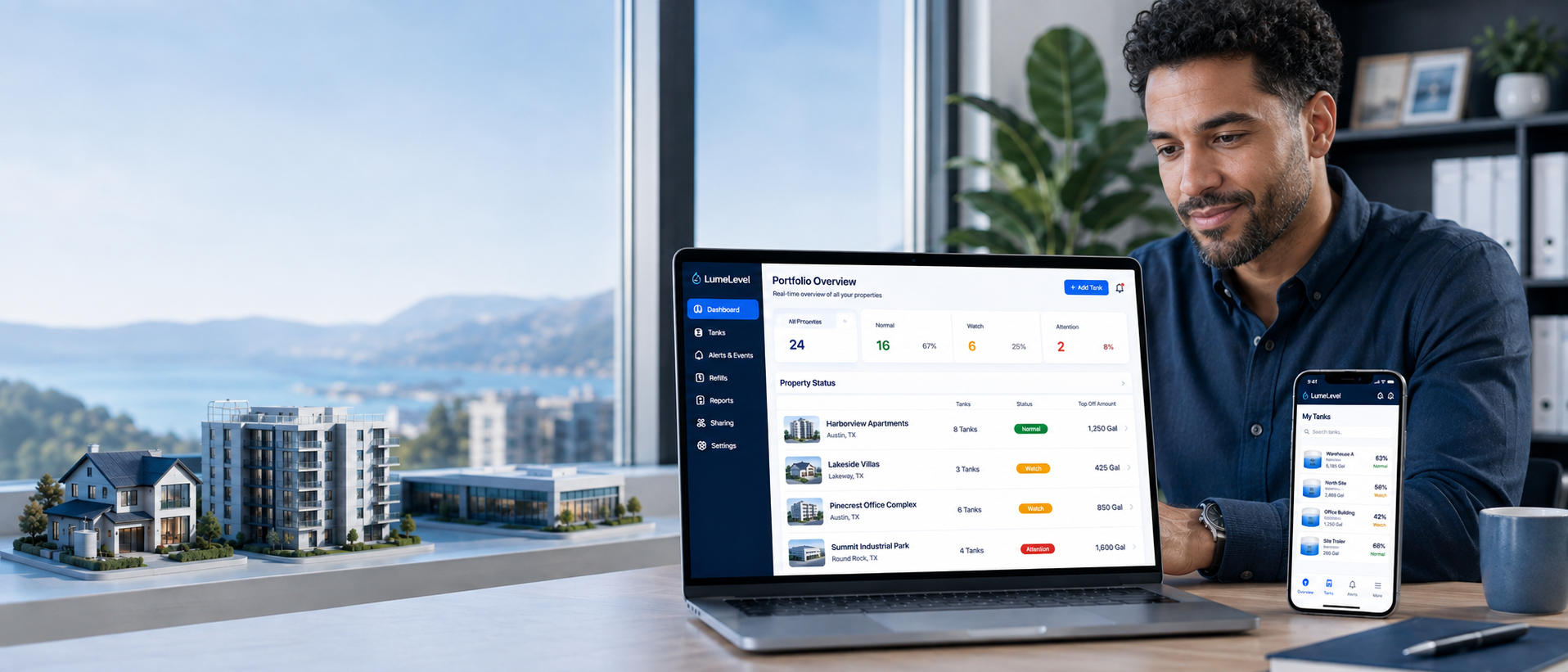
Bring billable owned and shared tanks into one operating view across managed properties.
Let normal conditions stay visible while properties on watch or needing attention rise to the top.
Share relevant visibility with owners, caretakers, suppliers, and service providers when action is needed.
LumeLevel turns distributed tank information into one operating picture so normal properties stay visible and attention can move toward the locations that actually need action.
See owned and shared tanks across the managed portfolio from one operating view.
Let normal conditions stay visible while properties needing attention rise to the top.
Share the relevant operating picture with staff, owners, suppliers, and service providers.
Start manually and automate only the tanks where continuous visibility earns its place.
The goal is not to eliminate every property visit. It is to use better information to decide which visit, call, refill, or investigation deserves attention first.
Build the operating picture manually or with Pebble.
See normal, changing, and unusual conditions together.
Identify the properties that deserve attention first.
Give the right people the visibility needed to respond.
Add continuous monitoring where the operating value is proven.
Avoid sending somebody to a property simply to discover that no tank action was needed.
Investigate changing conditions before the tenant, guest, or owner becomes the first alert.
Give teams a shared reference instead of rebuilding the situation through calls and handoffs.
Share appropriate visibility when refill timing or service coordination depends on current tank status.
Monitoring, maintenance, coordination, or equipment rental may become part of the property service relationship.
Deploy Pebble where continuous visibility saves enough time, uncertainty, or coordination effort to justify it.
There is no single Property Manager business model. Start with the role your company already performs and add only the services that fit.
Use LumeLevel as part of the management service you already provide.
Where it fits your business, the managed property relationship can support additional paid services.
If installation belongs in your service business, a Property or Facilities Manager may separately qualify as a LumeLevel Certified Installer.
The detailed tools remain available, but the business case starts with the operating model—not a spreadsheet.
See the current portfolio tier, occupied tank slots, optional monitoring-service value, and selective Pebble rollout.
Explore the possible value of fewer dedicated check trips, recovered staff time, and earlier response.
Explore monitoring, rental, maintenance, coordination, and other service lines your company may choose to offer.
See the current Property Manager portfolio tier, optional service-value scenario, and selective Pebble rollout separately. Live subscription and hardware prices come from the LumeLevel catalog.
Hardware is optional in the scenario. Start manually and add Pebble where continuous visibility earns its place.
Monthly service-value scenario
—
Use the Test Drive to build a real operating record first. Hardware can be added selectively after you see where continuous visibility creates value.
Property management and LumeLevel monitoring do not have to be the only services in the relationship. Use your own prices and direct costs to explore optional installation, equipment rental, monitoring, cleaning, water coordination, and maintenance services. Leave any service you do not offer at zero.
Monitoring revenue uses the property count and monthly service value already entered in Step 2 above.
Model installation work only when the business is appropriately qualified and, where applicable, LumeLevel Certified.
The Property Manager owns the equipment and charges a recurring rental or equipment-service fee while the hardware remains deployed at managed properties.
This uses the Pebble model and hardware purchase quantity from Step 2. The commercial unit price reflects the existing LumeLevel quantity-discount structure.
Rental position = monthly rental amount left after entered direct rental costs × months − the commercial hardware acquisition cost allocated to the rental units. It does not include portfolio subscription, financing, taxes, replacements, idle periods, or costs not entered.
Model routine checking and reactive-response costs separately from platform economics. Replace the starting assumptions with figures that reflect your own portfolio.
Combined routine-check and reactive-response scenario based on the assumptions entered.
Potential hours per year
Potential annual operating value
Illustrative annual value if earlier information reduces or mitigates the entered share of reactive events.
The goal is not a promised staff-capacity multiplier. It is a more manageable operating model built around better information and clearer priorities.
Properties may receive routine checking because the team has no reliable way to know which locations actually deserve attention first.
Staff can investigate the properties whose tank status or history suggests that a check, refill, or other action may be required.
See what organized tank visibility looks like in the LumeLevel dashboard.